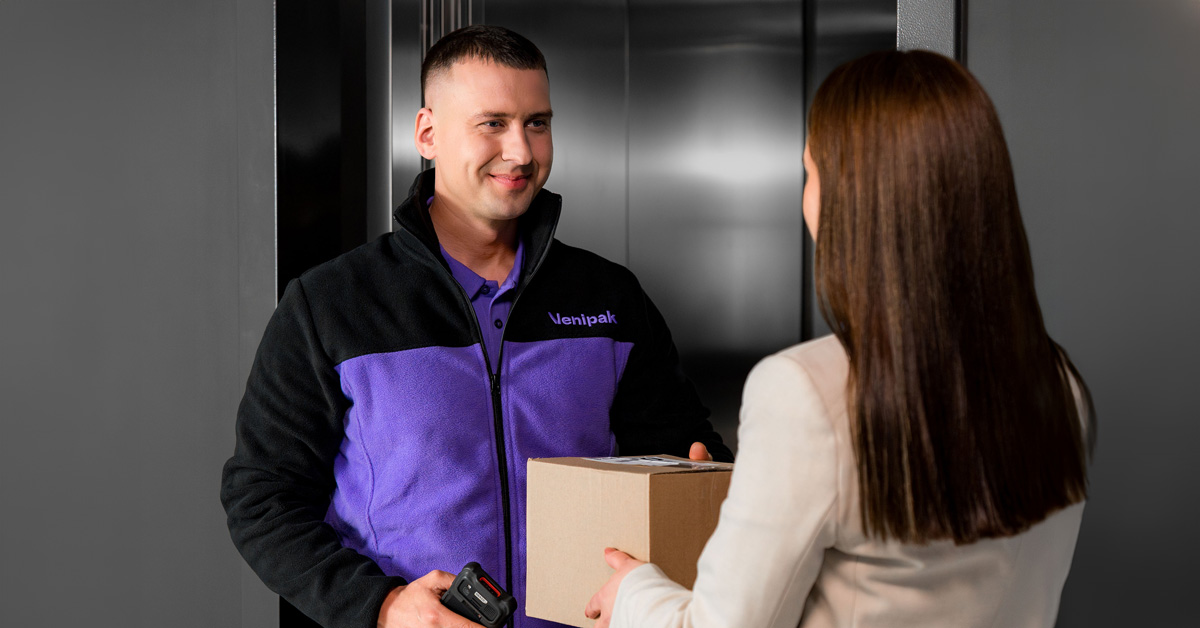
Complaining about couriers has become almost second nature to us: if a parcel is late, we blame the courier; if we aren’t home during delivery, we usually pin the fault on them again. Yet, in our daily lives, we let couriers into our most private spaces – right to our doorsteps. They know our addresses, phone numbers, door codes, and even when we are or aren’t home. Paradoxically, the person who knows so much about us usually remains anonymous.
The parcel delivery company Venipak has decided to change this: from now on, all of its couriers in Lithuania will introduce themselves to customers by name. The move aims to shift the culture of the logistics sector and increase respect for the courier profession.
Breaking stereotypes about the profession
Until now, communication between couriers and customers was mostly limited to standard phrases about delivery times. Now, Venipak couriers will provide their names when calling customers.
“Introducing oneself by name is the simplest yet most effective way to build a connection with customers. We want the customer to know that it’s not just ‘someone from Venipak’ coming to them, but a specific person – Jonas, Tomas, or Andrius,” says Laura Buitkuvienė, Head of Human Resources at Venipak.
According to her, this change is a strategic step toward making the courier profession more prestigious and visible.
“We want to ensure that a courier’s job isn’t just associated with carrying heavy boxes, but becomes an example of professional customer service. We want to break established stereotypes and create a culture where the profession is respected and the couriers themselves are more valued. Having couriers introduce themselves by name is the first step in this initiative,” L. Buitkuvienė explains.
Focus on emotional well-being
A courier’s daily routine consists of more than just hundreds of kilometers driven; it involves constant pressure to deliver on time and frequent interaction with customers. Often, the courier is the one who has to bear the brunt of a customer’s dissatisfaction over delayed goods or other circumstances beyond their control.
“The work of a courier is physically and emotionally demanding, so a personal connection can act as a kind of shield. When a customer knows the courier’s name, the relationship becomes less formal. It leaves more room for simple humanity and understanding, which is often lacking in this profession,” notes L. Buitkuvienė.
She believes that respectful, mutual communication correlates directly with service quality – a motivated and respected employee always goes the extra mile.
From a name to a sincere compliment
The personal introductions complement an ongoing campaign where recipients are invited to leave compliments for their couriers. Customers who receive a parcel from a Venipak courier can visit venipak.com/lt/savaskurjeris/ to leave positive feedback in Lithuanian.
As L. Buitkuvienė points out, once a courier stops being anonymous and becomes a specific individual, it becomes much easier for people to notice and appreciate their effort and professionalism.
“Couriers don’t just know customer addresses; they often know the safest places to leave a package or even our pets’ names. We invite recipients to notice these efforts and reciprocate with a bit of attention. We believe that by knowing the courier’s name, customers will feel more comfortable leaving a compliment, and the courier, feeling valued, will be even more motivated to excel,” says L. Buitkuvienė.