


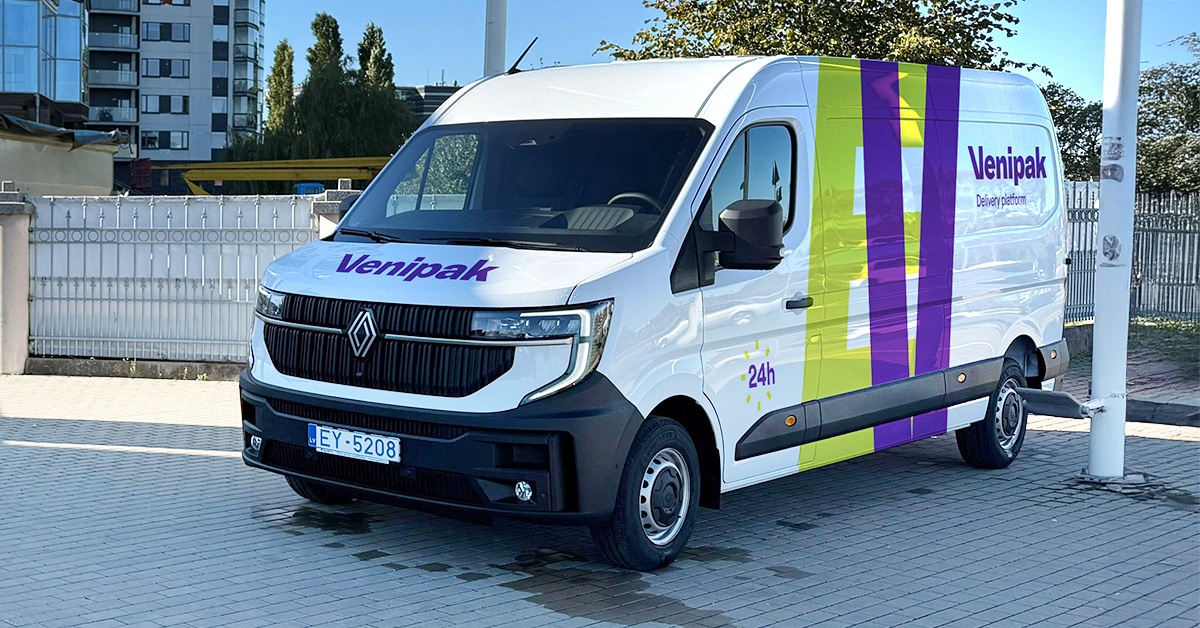
The international parcel delivery company Venipak is thoroughly reviewing its sustainability strategy to achieve tangible and measurable change.
“We have already started with electric minibuses, first testing them in Latvia,” says Venipak CEO Andrius Ladauskas. “Our first electric vans are currently on the road, and we are testing the vehicles’ durability in order to introduce them across the entire Baltic region.” The company’s goal is that by 2029, 10% of its entire vehicle fleet will be electric.
Venipak is also revising its warehouse network, moving operations to energy-efficient facilities and optimizing the logistics network to reduce CO₂ emissions from last-mile transport by 62 tons annually.
As an example of energy efficiency, Ladauskas points to Venipak’s largest logistics terminal in the Baltics, opened in Kaunas in the spring. It has an A++ energy efficiency standard and serves not only as a warehouse but also houses the parcel sorting center and office spaces. The site includes charging stations for electric vehicles and significantly larger administrative areas with staff rest zones.
Technology plays an important role in enabling more sustainable operations. Venipak is testing and implementing automation and AI-powered solutions throughout the company. “Technology has become the driving force behind what we do. We are focusing on optimizing courier routes. For this, we need to find the most efficient tools to simultaneously increase productivity and reduce transport time. Innovation reaches every part of our company—from smart planning and cost reduction to the end customer, for whom using our services is becoming increasingly convenient,” Ladauskas comments.